
Ballance
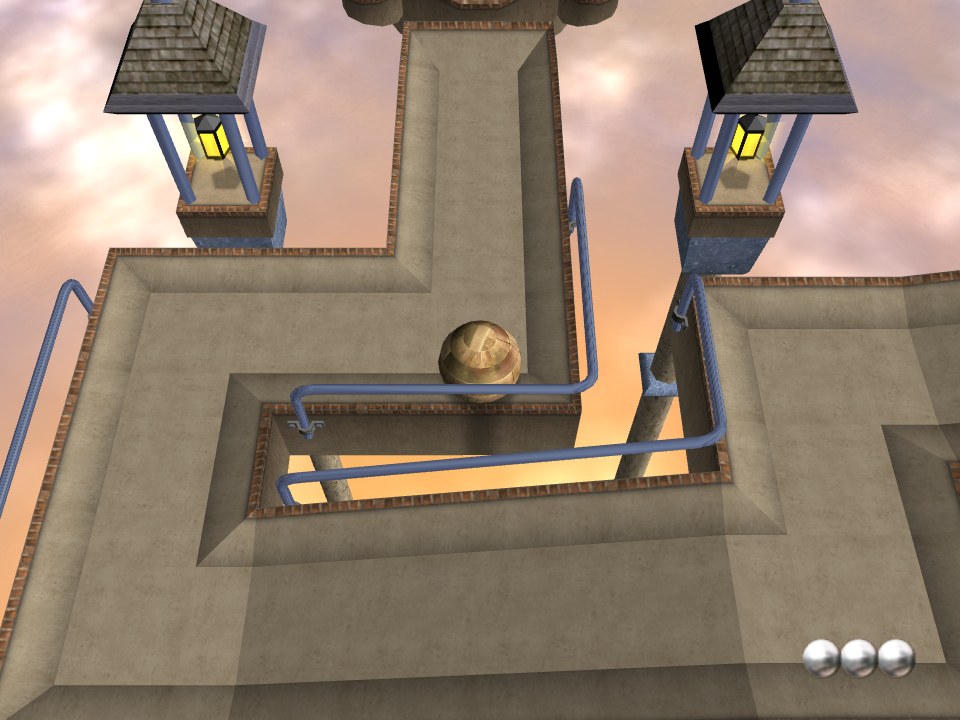
- Original
- 2004 · Cyparade / Atari
- Technology
- Windows · Virtools (CK2) · Ipion physics
- Approach
- Script runtime + physics port
- Status
- Playable · 0.1.3 — All levels, running the game's own Virtools scripts
- You bring
- Your Ballance CD or an installed copy
Ballance is a quiet, exacting game. You roll a ball through tracks suspended in the sky — rails, ramps, seesaws, turnstiles — and at certain points a transformer changes it from wood to stone to paper, each with its own weight and grip. Cyparade made it and Atari published it in 2004, on a multilingual CD whose German installer also carries English, French, Spanish and Italian. Twelve levels, a tutorial, a highscore table, and physics that feel exactly right or not at all.
It is worth preserving for an unusual reason. Almost none of Ballance is native game code. It was built in Virtools Dev 2.1, an authoring tool in which the game's logic is drawn as behaviour graphs and saved into .cmo and .nmo files, then run by a generic Virtools player and a stack of engine DLLs. The game lives or dies with that runtime, and with the Ipion physics engine inside physics_RT.dll. When those DLLs stop running, the game goes with them, even though its scripts are sitting intact on the disc.
OpenBallance is complete and released. The boot sequence, the intro, the whole menu, the tutorial and all twelve levels play — modules, transformers, extra points, checkpoints, sectors, lives and score, pause, game over and highscores — with sound, music and the original keyboard and mouse controls, including rebinding. The project's own status page lists what remains: the physics has not yet been compared numerically against recordings of the original, a debug text overlay is not drawn, 3D sprites are unlit, and a few debug-only blocks report zeros.
How it was rebuilt
The obvious approach would have been to read the behaviour graphs and translate them into C, one by one. The initial analysis considered and rejected exactly that. Ballance has 4,469 behaviour nodes; hand translation would have meant re-deriving Virtools' scheduling — link delays, priorities, parameters pulled through operations — separately for every graph, with subtle ordering bugs that look like gameplay bugs. Instead OpenBallance is a script runtime. A new CK2-compatible runtime loads the files from your copy and executes the original graphs, so the game's logic is the game's own.
That turned the job into three bounded ports. The behaviour scheduler was ported from CK2.dll, with the addresses cited, and written up as a specification of the frame loop, activation, link delays and parameter propagation. The Building Blocks the graphs call — 184 distinct ones across 3,885 uses — were ported one by one from their DLLs, one C file per original DLL, each declaration checked by script against a map of GUIDs, DLLs and execute functions dumped from the binaries. And the physics is a function-level port of the Ipion engine from physics_RT.dll, which ships with no symbols and no RTTI: subsystem names were inferred from call graphs, constants and a handful of strings, including a German error message in the OV-tree. The rule on physics was clean-room — port from the project's own decompilation, and do not consult the leaked Ipion source.
The tooling came first. Python readers for the CK2 file format dump every graph, with its parameters and links, to text, and most questions were answered there rather than in disassembly. Ghidra did the rest, with scripts to coax it into finding functions it missed at import: re-analysis took VxMath.dll from none to 726 functions and CK2.dll from 54 to 2,794. Where the decompiler misread x87 code or merged stack slots, the disassembly won. Large subsystems were specified in writing before they were ported, with confidence tags on each claim.
The new code is the platform underneath: a renderer that reproduces Direct3D 7/8 fixed-function lighting, fog and specular in a single WGSL shader on gasm's graphics interface, a guest audio mixer, a Microsoft Video 1 decoder for the intro movie, an ISO 9660 reader, and an InstallShield cabinet reader with its own DEFLATE so the game can run straight off the CD. One file, src/platform_gasm.c, talks to gasm; everything else sees a small platform contract. The source is about 27,100 lines of C — 9,600 of them physics, 7,200 Building Blocks and 6,400 the CK2 runtime — alongside roughly 14,800 lines of Markdown documentation, most of it specifications of Ipion. The public history begins with a single squashed import of the working port on 1 October 2026; the fixes that follow, up to release 0.1.3, are dated between then and 3 October.
Notable stories
Waiting for the runtime
When the port began, gasm had no textures, samplers, viewports or depth bias, and OpenBallance needed all of them. Rather than work around the gap with a software rasteriser, the project wrote a formal requirements document for gasm's graphics interface — addressed to the agent that would implement it — and kept the rasteriser only as a contingency. Everything requested landed in gasm 0.4.0. The same patience paid off again with input: a keymap file, launcher flags and a layout editor in the browser player were all deleted once gasm 0.5.0 offered raw keys, which are mapped onto DirectInput scan codes so the game's own key settings work as they did. Evidence: design/gasm-gfx-requirements.md, 9bcd96d.
No checkpoint ever fired
After launch, no checkpoint fired, and later sectors — level 3's turnstiles among them — never activated. The Building Blocks were fine. The fault was in the runtime: a local parameter saved with identifier 0x200 is a "myself" parameter, whose value is the object that owns the behaviour. The loader ignored the flag, so the checkpoint's arming proximity test had no second object and stopped on its first frame. Evidence: 139f665.
The ball that vanished in the transformer
Rolling into a transformer exploded the old ball and placed no new one. Virtools forwards a changed output parameter through chains of destinations, so a graph output that exports an inner one passes the value on to its own destinations in turn. The port stopped after one hop, and the new ball type never reached the variable that chooses which ball to create. Recursive propagation, with a depth limit, brought it back. Evidence: 3483df7, src/ck/ck_param.c.
Points falling thirty times too fast
Two more runtime details surfaced in one commit. Writing a parameter into a data array goes through a copy that requires compatible types; without the check, a boolean landed in a float cell and the score drained at 60 points a second rather than 2. And Show on a group shows its members, recursing into children, which is why the HUD had been invisible. Every post-release bug shared this shape — generic engine semantics, not game logic — and the lesson the project draws is to inspect the runtime around a graph whenever a feature fails silently. Evidence: a60bef7.
Deterministic, not bit-exact
Ipion simulates on the x87 with a 64-bit mantissa, at twice real time, in fixed steps of 1/66 of a second, with gravity set by the game to -20. The port uses doubles for intermediates and rounds to single precision exactly where the original stores a float; its own specification puts it plainly: deterministic, not bit-exact, and nothing can be. One ordering in the original depended on the memory address of each ball, which no port can reproduce, so a stable key replaces it. Evidence: docs/ivp_core.md, docs/physics.md.
Gallery
Standing on shoulders
The community-published Virtools SDK 2.1 headers supplied vtable order and method names, and the public Ipion sources supplied class and field names; the leaked Ipion source was deliberately not consulted. The InstallShield cabinet layouts come from the documentation and sources of unshield — no code taken. The behaviour of the qhull library linked into physics_RT.dll was documented and replaced by a small hull builder.
Tools throughout: Ghidra, ghidra-cli, Capstone and wasi-sdk. Gaps in these credits are bugs — tell us.
Getting a copy
OpenBallance ships no game data and converts nothing; it reads your own copy of Ballance as it runs. It accepts a disc image (Ballance.iso, or the .bin of a bin/cue pair), the CD itself or a folder copied from it, or an installed game folder containing base.cmo, 3D Entities/, BuildingBlocks/, Sounds/ and Textures/. On the CD the game sits inside InstallShield cabinets (Setup/data1.hdr, data1.cab, data2.cab); OpenBallance decompresses and checks each file as the game opens it, so nothing needs installing or extracting. The language — English, German, French, Spanish or Italian — is a launch parameter.
The project's game data guide has the details, with installing, running on gasm, playing in the browser (WebGPU is required) and launch parameters. Releases for macOS, Linux and Windows, and the bare .wasm, are on the releases page.
Further reading
On the project site, the status page sets out what works and what does not, and the internals begin with the architecture and the initial analysis that chose a script runtime over translation. The Virtools runtime specification and the gameplay Building Blocks describe the engine; the physics is covered from the physics manager down through IVP core and dynamics, collision detection and contact response. The reverse-engineering workflow and headless runs show how the work was done.
Among the ENCORE guides, OpenBallance is the clearest case study in choosing an approach — when to run a game's scripts rather than port its code. The reverse engineering workflow, file formats and game data, floating point and the compiler, building for gasm, graphics, audio, input, working with agents and lessons learned all draw on it.