
Return Fire
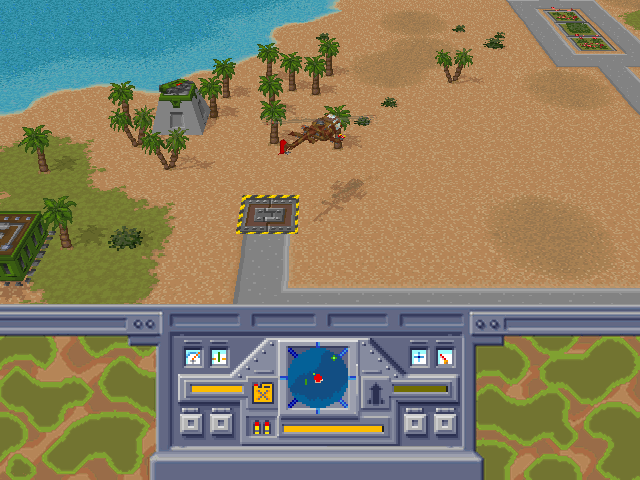
- Original
- 1996 · Silent Software / Prolific Publishing
- Technology
- Windows 95 · DirectDraw 8-bit · DirectSound · Cinepak
- Approach
- Function-by-function port
- Status
- Playable · 0.4.0 — Whole game, one and two players
- You bring
- Your Return Fire Windows 95 CD (folder, .iso or raw .bin)
Return Fire is capture the flag with armour. Each side has a bunker, a lift, four vehicles and a flag hidden among decoys somewhere on an island; you choose a tank, a helicopter, a jeep or an armoured support vehicle, ride it up to the surface and go looking for the enemy's flag while their turrets, drones and soldiers do their best to stop you. Only the jeep can carry the flag home. It began on the 3DO in 1995 and came to Windows 95 in 1996, with the same top-down island war, a split-screen two-player mode and a soundtrack of classical music that a small music director moves between as the game goes on.
The Windows edition is worth keeping for a particular reason: its renderer is a software emulation of the 3DO cel engine, writing 3DO-style cel lists into a locked DirectDraw surface. That is an unusual piece of history in its own right, and it depends on DirectDraw 8-bit modes, Video for Windows Cinepak decoding and a music system streamed through AVIFile into DirectSound — exactly the sort of plumbing that modern systems no longer provide.
OpenRF is a function-by-function reimplementation of RFIRE.BIN, the real game program on the CD, with the same 16.16 fixed-point maths and the original's quirks kept. The whole game is ported for one and two players: intro and movies, title, the music director, bunker selection and the lift, all four vehicles, weapons and damage, turrets, the drone, the submarine, soldiers, gates, the flag, random mines, win and loss sequences, high scores and the two-player split screen with spectating. A few things are not ported yet — the Win32 menus and dialogs (replaced by title-screen keys and launch parameters), pause in two-player, the two-player bunker status screen, drone radar blips and record/replay among them.
How it was rebuilt
The starting point was a Ghidra project of RFIRE.BIN (431,616 bytes, CRC-32 64c49a1b), driven headlessly through a command-line client, with a script that dumps the whole program as named decompiled C into a git-ignored folder so code, documentation and Ghidra all share the same names. Ghidra counts 897 non-external functions, of which around 416 were renamed. By the project's own estimate roughly 60% of them are real game logic and 40% runtime library, Win32, DirectX and Video for Windows glue.
Before any porting, the architecture notes laid out a recommended order — platform shell, asset loaders, cel rasteriser, world view, object system, vehicles, weapons, enemies, HUD, sound and music, front end, then two players and replay — and each file format was given its own document and a Python decoder before any C was written. Every ported function cites the original's name and address in a comment. Nothing is copied out of the executable into the source: the game's tables are read at run time by mapping the PE sections of the user's own RFIRE.BIN, which is why exactly one build is supported.
The portable core is about 17,100 lines of C11, with about 2,150 lines of tests and some 2,950 lines of Python tools. New code covers what the original got from Windows: a file layer that reads folders or ISO 9660 disc images directly, its own Cinepak decoder written from the public bitstream description, a single audio mixer, and one platform backend for gasm, which runs the same WebAssembly module on macOS, Linux, Windows and in the browser. The repository starts with a squashed initial import (161 files, a complete native macOS build) followed by 31 commits over four days of agent time that added the disc reader, the portable core, the gasm backend, the browser player and the bundles, and finally made gasm the only target.
Notable stories
Drawing is part of the simulation
Return Fire's draw pass does more than draw. Turrets are activated from the rendering of their model, soldiers are removed after 120 ticks of not being drawn, wreck timers count from the last tick a wreck was drawn, and the idle drone checks whether enemy turrets were in view last frame. A headless simulation that skipped rendering would quietly play a different game, so OpenRF's tests always render the view. The finding is recorded in the "Traps" section of the project's agent instructions, alongside the other hard-won facts that must not be reintroduced.
A bit-exact renderer, checked twice
The world view renderer (RenderWorldView) was first ported to Python at the integer and bit level, as tools/view.py, and only then to C. A comparison tool, tools/render_cmp.py, runs both over fixed scenes and seeded random ones and diffs the 8-bit index buffers; the requirement is zero mismatches. The exact projection tables, matrices and sort rules are written up in the rendering notes.
Colours ten places off
Sprite pixels in ART.CAR do not index the game's own palette but the DirectDraw palette, where the game's colours start ten slots up because slots 0–9 and 246–255 belong to Windows. This was spotted visually — water and sand only looked right with the shifted palette — and then confirmed in the disassembly. Status bar images need the same offset when they are drawn. The details are in the ART.CAR notes.
Blocking loops become frame steps
The original runs nested blocking loops for the intro, title, game and end sequence. gasm calls the game once per frame, so every one of those loops became a state with a step function, where one step is one iteration of the old loop. Because presents and clock reads happen in the same order as before, output stayed byte-identical to the blocking version (1247f21). With a virtual clock of one 16 ms tick per frame at 62.5 Hz, headless runs produce fixed video and audio hashes that must match on the native runner, the Node runner and the browser.
When the runtime moves under you
Two updates of the browser host broke the play page without breaking the build. One version made the worker import a WebGPU module that had not been vendored, so the page never started (4f57aec); a later one changed how frames and input are passed, and the raw keyboard silently stopped reaching the game until the call was updated (9492abc). The same commit retired the native SDL app, leaving gasm as the only way the game ships. The lesson the project draws is plain: read the runtime's changelog on every pin bump, and run the browser test again.
Asking the runtime for what the game needs
Early gasm loaded whole assets into memory, which for a 285 MB CD meant a heavy, slow start. Rather than work around it, OpenRF wrote a requirements document for the runtime's own maintainers — design/gasm-host-requirements.md — asking for file-backed assets, a folder-as-assets mode with case-insensitive lookup, a Worker mode with an OPFS provider and a second keyboard layout, each with acceptance criteria. Those features landed in gasm 0.3.0, and the browser player now reads an imported CD lazily from the browser's own storage.
Gallery
Standing on shoulders
All format knowledge comes from disassembling RFIRE.BIN itself; the project credits no community wikis. It leans on public standards and descriptions: ECMA-119 (ISO 9660) for the disc reader, a public description of the Cinepak bitstream for the movie decoder, and the 3DO cel engine's API names (CCB, PLUT) for the renderer, inherited from the 1995 3DO original the PC engine grew out of.
Tools throughout: Ghidra, ghidra-cli, Capstone and wasi-sdk. Gaps in these credits are bugs — tell us.
Getting a copy
You need the Windows 95 edition of Return Fire on CD. OpenRF reads the folders ART, SOUND, TITLE and WORLDS and the file RFIRE.BIN from the root of the disc; the other folders are not used. RFIRE.BIN is checked against the one supported build: 431,616 bytes, CRC-32 64c49a1b. The project was developed against the European release (English, French, German, Spanish and Italian). The 3DO version uses different file formats and is not supported.
The CD can be given as a folder (the disc itself, a mounted image or a copy) or as a disc image read directly: a plain .iso, or a raw .bin with 2352-byte sectors in MODE1 or MODE2. The bundles and the browser player refuse a .cue; choose the .bin next to it instead. The project's game data guide covers this in full, with installation, running on gasm, extracting a CD image and troubleshooting alongside it.
Further reading
The OpenRF site has the user guide, the controls and vehicles, and the internals: the architecture, rendering and game simulation notes, the portable core, and the file formats — ART.CAR, RFM maps and STM movies. Its reverse engineering how-to describes the Ghidra workflow.
Among the ENCORE guides, OpenRF illustrates porting function by function, the reverse engineering workflow, file formats and game data, determinism and verification, building for gasm and graphics, audio, input. Shipping covers the browser player and release bundles, and working with agents and lessons learned pick up the "Traps" habit and the cross-repository requirements document.