
Babo Violent 2
- Original
- 2008 · RndLabs / Freeware; source later released under GPL-3.0
- Technology
- Windows · OpenGL 1.x · FMOD · baboNet
- Approach
- Source port
- Status
- Playable — Client, hosting and a new multiplayer server
- You bring
- Nothing: the game content is GPL and comes with it
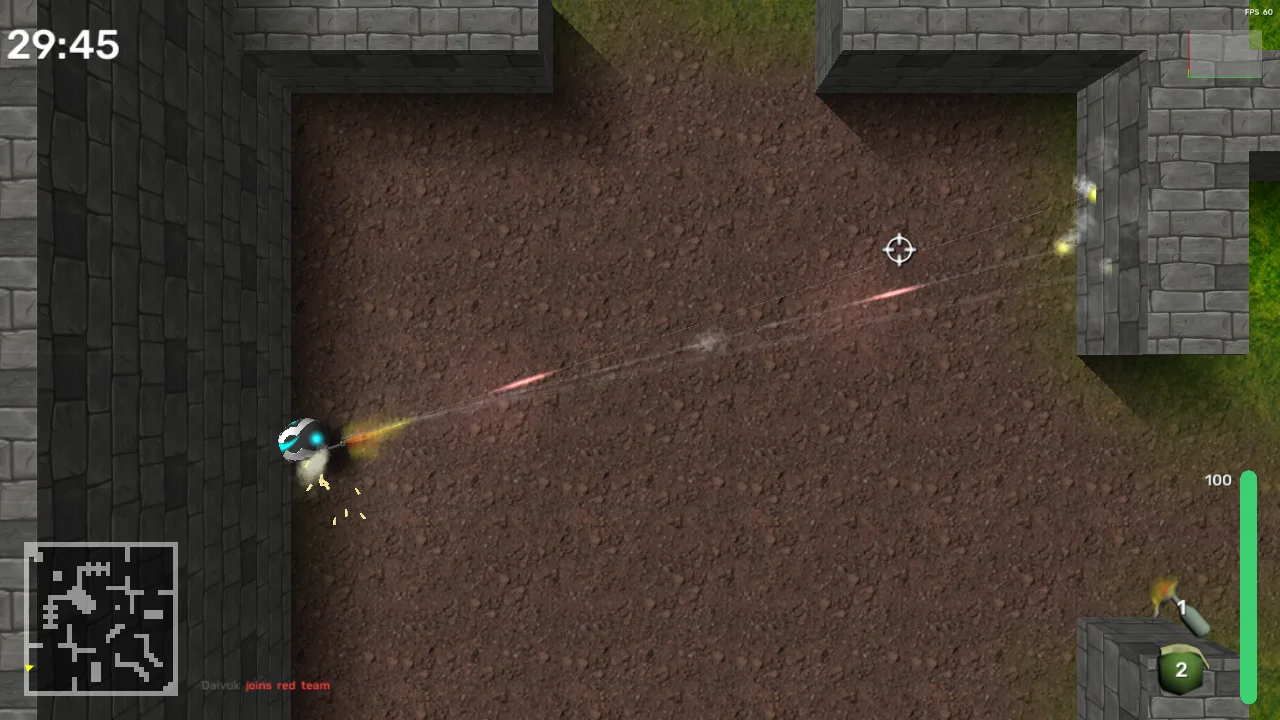
Babo Violent 2 is a top-down multiplayer shooter in which every player is a ball — a babo — rolling round small arena maps with guns, grenades and, in capture the flag, flags to carry home. It was RndLabs' freeware game, and version 2.11 was the last release they shipped. It was built for playing against other people, through dedicated servers and a master list of games, and the original master server no longer answers; without one, the Game Browser has nothing to show.
It is also the odd one out in this collection. Its C++ source, © 2012 bitHeads inc., was released under the GPL-3.0 by David St-Louis (Daivuk), so openbv involves no reverse engineering of the client. The game and engine code are compiled as they were written, and only the Windows platform beneath them — window, loop, input, OpenGL, FMOD, sockets, files, the embedded database — is replaced. The genuinely new work is a multiplayer server in Go, written from a specification of the original C++ server and checked against it bit for bit.
openbv is playable: menus, hosting a game in-process, local play, sound and the browser player all work, and the Go server has reached its fifth milestone, covering every game type, votes, bans, in-game admins, an admin web page and a master list. What is still missing is recorded honestly in the project's status page: gamepad buttons, Game Browser pings, LAN search, the remote admin tool, the account server, most of the Prozac mod's changes, and other players joining a game hosted from a client.
How it was rebuilt
The reference is the Windows ProRelease build of 2.11 (the _PRO_ configuration); where the source has Windows and Linux branches, Windows behaviour wins. The upstream source was imported at commit 7171c84, normalised to UTF-8 and LF line endings, in a commit of its own, so that the port commit that follows shows exactly what changed and nothing else. Every in-source change is marked OPENBV_GASM, and there are twelve such markers across roughly 99,500 lines of vendored game and engine code.
The original was Win32 with fixed-function OpenGL 1.x, DirectInput, FMOD 3.75, Daivuk's own baboNet networking DLL, SQLite and libcurl, with the "DukZeven" engine split across several DLLs. All of that now lives in src/port/, about 9,600 lines (of which some 3,100 are a generated file of embedded assets): a GL 1.x implementation on gasm's GLES 3, an FMOD 3 shim over a software mixer, baboNet over WebSockets, file calls wrapped at link time, and a reader for the SQLite file format standing in for SQLite itself. The original WinMain is cut in three — initialisation, one frame, shutdown — so that gasm's runner owns the loop, while the game keeps its own 30 Hz tick inside a 60 Hz frame.
The server, in server/, is about 13,900 lines of Go, including some 2,700 lines of tests. It was written from design/server.md, a 2,305-line specification of the C++ server with file-and-line citations: the authority split between client and server, the 21-step frame order, every message, the handshake, map download, the RNG, eighteen quirks to keep and a table of bugs not to keep. The public history is short — sixteen commits over 9 and 10 October 2026 — and the commits are written as small design documents, with their verification quantified.
Notable stories
Two copies of the same classes
On Windows the engine DLLs and the game each carried their own CString, vector and matrix classes, and they were not the same: the engine's EPSILON was 0.01 and the game's 0.0001, and one parsed integers with sscanf("%i") where the other used atoi. Link both into a single WebAssembly module and the one-definition rule quietly merges them, so one side gets the other's maths. The fix keeps both: the engine is compiled with a forced include of engine_names.h, which renames its copies (CString becomes dkString, and so on), and the functions that used to cross the DLL boundary get a fixed link name on both sides through openbv_link.h. The layouts are identical, so nothing else had to change.
OpenGL 1.x, done on the CPU as the spec says
The game draws in immediate mode, with display lists, attribute stacks and a gluSphere for every babo. Rather than translate those calls into something modern, src/port/gl1 provides real GL 1.x entry points and performs transform and lighting on the CPU per the specification — eight lights, Blinn specular, spot lights, attenuation, colour material, three fog modes — handing the GPU clip-space vertices and a single shader. Because the maths runs in WebAssembly, it is identical on every runner. Smaller faithfulness details matter too: the game blends with destination alpha and copies the screen into textures, so it draws into an offscreen framebuffer with an alpha channel; mipmaps follow SGI GLU's rounding; an incomplete texture turns texturing off as GL 1.x does, rather than drawing WebGL's black.
A WebSocket transport that is faithful by accident
gasm guests have only WebSockets: reliable, ordered, binary, and unable to listen. That looks like a poor fit for a game whose networking layer offered TCP, UDP and a peer-to-peer UDP channel. Reading the source showed that Server::host creates its baboNet server with UDP disabled, so every "UDP" message in a real game already travelled on the reliable TCP stream. A WebSocket transport is therefore faithful to what players actually ran. babonet_gasm.cpp keeps the semantics the game depends on as well as the bytes: one event per bb_serverUpdate call, connections admitted only at half-second checks, the first client's packets drained before the next. Hosting a game builds an in-process loopback server that the game's own client reaches through 127.0.0.1.
A server checked bit for bit, in another language
The second milestone, deathmatch combat, is where the Go server had to agree with the C++ one to the last bit. Clients recompute scores from the hits the server reports, so the server must produce exactly the same hits. The original functions are extracted from the C++ source and compiled natively in server/internal/reftest, producing golden data the Go code is tested against. Matching them required two things: rounding each product to float32 explicitly, because Go fuses multiply-add on arm64, and porting musl's sinf and cosf to Go, because a correctly rounded cosine differs in the last bit and (short)(x*100) amplifies that into a different coordinate. A recorded session from the C++ listen server was replayed against the Go code: 38 of 41 shots matched byte for byte, and the other three were skipped because the muzzle sat inside a wall, which the log cannot reveal. A later commit made the golden tests compare NaNs as NaNs, after data recorded on arm64 failed on x86-64 over NaN sign and payload bits.
Misleading indentation, and a hostname that does not fit
Two smaller lessons came from the original's own text. The specification first got the frame order wrong, because CTF and auto-balance sit inside the GAME_PLAYING block and the original's indentation makes that easy to miss; it was corrected with milestone 4. And the master list's ip field is sixteen bytes, exactly one too few for openbv.emdzej.pl. Milestone 5 patched the client so that an empty address means the master's own host and grew the buffer from 16 to 256 bytes. The same milestone dropped some of the original's behaviour on purpose: passwords sent in clear to every browsing client now go out as *, map names are confined to the map folder, and each deviation is listed in the specification's §8.4.
Fidelity for gameplay, a dated carve-out for presentation
openbv's AGENTS.md states that fidelity is the product for gameplay, with an explicit exception for presentation recorded with the date of the user's decision. The UI canvas widened from 800×600 to 1066×600 units for 16:9, and the menus were redesigned with flat translucent panels and the Rubik typeface baked into the engine's own TGA font format. The HUD was restyled to match in one commit and mostly reverted in the next, keeping only the new health gauge and scoreboard. The same file pins a golden hash for frame 600, the main menu, and requires that any change altering it be explained by the change.
Gallery
Standing on shoulders
openbv exists because RndLabs, bitHeads and David St-Louis (Daivuk) released Babo Violent 2's source under the GPL, data included. The upstream source carries TinyXML (Lee Thomason), FastDelegate (Don Clugston), and MD5 implementations from RSA Data Security and Christophe Devine. The port adds stb_vorbis (Sean Barrett) for music and the Rubik typeface (OFL) for the redesigned menus; the community Prozac mod was a secondary reference.
Tools throughout: Ghidra (for the Prozac build) and wasi-sdk; the Go server uses coder/websocket and go-oidc. Gaps in these credits are bugs — tell us.
Getting a copy
You need to bring nothing. The game's content — bv2.db and the main/ folder, 328 files and about 18 MB of maps, models, textures, sounds and music — is RndLabs' work and is not covered by openbv's licence, but it is published in the same GPL source repository as the code. openbv never commits it to git: tools/fetch-content.sh pulls it from the pinned upstream commit and verifies the file count and a SHA-256 of the tree, and the release bundles and the browser player ship it ready to use. Data from the Prozac mod is optional.
The quickest way in is the browser player; Playing in the browser explains how it caches the data and keeps your settings. Getting started covers the native bundles for macOS, Linux and Windows and building from source, and Controls lists the keys. To host games, Hosting describes the in-process server and Running a server the Go server, its admin page and its container image. Building has the details for compiling it yourself.
Further reading
On the project's own site, Internals describes the architecture and Networking the transport and protocol; Status tracks what works and what does not, and Credits records the licences. The server specification, design/server.md, is the most complete account of how Babo Violent 2 plays over the wire.
Among the ENCORE guides, Choosing an approach explains when a source port is the right answer, and Networking draws heavily on openbv's server. Graphics, audio, input covers the platform shims, Building for gasm the runtime, Determinism and verification and Floating point and the compiler the bit-exact testing, and Modern additions the 16:9 and menu work. Browser player, releases, docs, Working with agents and Lessons learned round it off.