
Colin McRae Rally 2.0
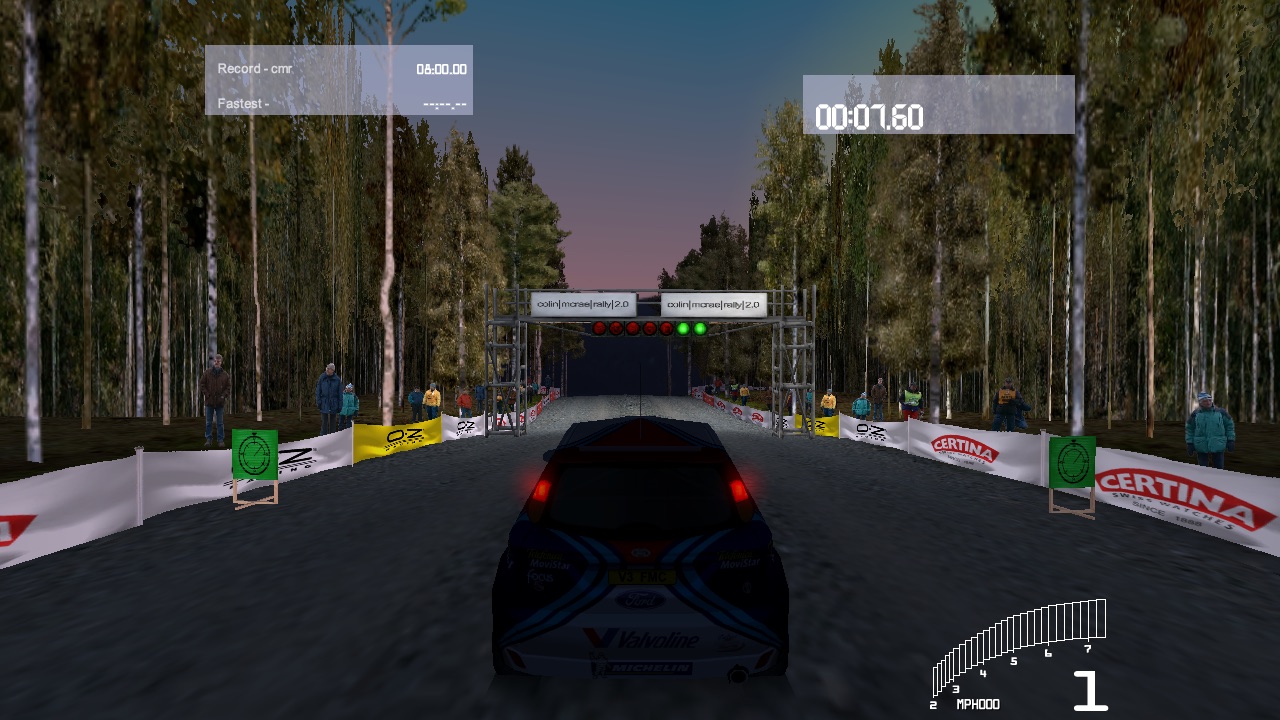
- Original
- 2000 · Codemasters / Codemasters
- Technology
- Windows · Direct3D 7 · DirectPlay · Bink
- Approach
- Function-by-function port
- Status
- Playable · 0.1.4 — Whole offline game; network play in testing
- You bring
- Your Colin McRae Rally 2.0 CD
Colin McRae Rally 2.0 is Codemasters' rally game for the PC: eight rallies of point-to-point stages on gravel, snow and tarmac, a co-driver reading pace notes, a service area between stages, arcade circuits and split-screen for up to four. Under the bonnet it is a careful piece of late-nineties engineering — a car simulation in 16.16 fixed point stepping at a fixed 25 Hz, AI drivers steered by small neural networks, and a renderer written against Direct3D 7's fixed-function pipeline. That last part is what makes it fragile today. It leans on DirectDraw mode enumeration, DirectPlay for network play and an ACM codec for its music, all of which have been quietly disappearing from modern systems.
OpenCMR2 is a function-by-function port of the game's program, CMR2.exe version 1.11, to C11 on the gasm runtime. It runs natively on macOS, Linux and Windows, and in the browser. The whole offline game is playable: rallies and championships, arcade, time trial and challenge, split-screen and hot-seat for two to four players, the service area, replays, ghosts, the movies and saves. The network game, rebuilt on a relay in place of DirectPlay, runs a full rally between two instances but has not yet been raced end to end. The latest release is 0.1.4.
The port keeps the original's behaviour rather than tidying it. Its project rules put it in four words — "fidelity is the product" — and its known issues include things the original does too: the disc's attract-mode demo runs drift off their recorded path, and the menus do not scale with resolution.
How it was rebuilt
The starting point was a Ghidra analysis of CMR2.exe — 3,583 functions and about 1,023 KB of code, of which roughly 3,250 functions and 950 KB remained to port once the statically linked zlib, D3DX and C runtime were set aside. Names live in a single tab-separated file of 1,969 entries, each with a confidence level, and an inventory maps the program by address range with anchor functions identified from strings and imports. The port plan was written as ordered steps, each ending in a concrete, machine-checkable test. Every ported function carries a /* Name 0x4xxxxx */ comment pointing back at the original address, and nothing is copied from the executable into the source: tables, strings and transition tables are read from the user's own CMR2.exe at run time, after a size and checksum check.
The game turned out to be structurally kind to a port. Its WinMain already calls one game frame per idle loop iteration, which maps straight onto gasm's frame callback, and its modes run on a tiny process framework of state slots and byte-triple transition tables that was ported as-is. The most consequential decision was the game state image: the original's whole data section is allocated as one block at start-up, its initialised part copied from the executable, and ported code reads globals by their original addresses. That keeps run-time-filled tables behaving exactly as they did, and — as it turned out — made the differential harness described below possible.
New code is confined to what Windows used to supply. A Direct3D 7 layer records device state with D3D7's own defaults and structure layouts, and a GLES 3 / WebGL 2 back end implements the two-stage texture combiner, vertex fog, alpha test and the full fixed-function transform and lighting in a vertex shader. A DirectSound emulation feeds one 44.1 kHz stereo mixer; a subset of DirectPlay 4 runs over gasm-relay rooms; a virtual file system reads host folders, ISO 9660 images and the InstallShield 6 cabinet, with its own inflate. The Bink 1 movie decoder was written from published format descriptions, and — the same trick as with the executable — reads its codec tables from the user's own binkw32.dll. Some things were deliberately left out and documented as such: 16-bit surface formats and their banding, mip chains, force feedback and compatibility with the original save format.
The result is about 65,200 lines of C in src/, plus tests, Python reference tools, a 900-line emulator harness and the browser player. The history runs to 327 commits over four days of agent time (31 October to 3 November 2026, not counting human review and testing); the whole offline game was ported in about three of them.
Notable stories
Running the original against the port
The standout tool is a differential harness built on the Unicorn CPU emulator. It maps CMR2.exe's code and constants at their original addresses and places the port's game state image over the original data section. Before each simulation step it copies the port's state into the emulator, runs the original machine code for the same pass, and compares the car blocks afterwards; any access outside the mapped regions stops with the address. With it, the car simulation became bit-exact over all 4,211 steps of the Fra01 demo, and it found faults no review would have: rounding from a 64-bit rather than 24-bit x87 model, spin damping and wheel forces that apply only with a corner on the ground, dents that move a vertex normal by three times the vertex's own move, and a damage counter decrementing every step (92859ab, tools/emu/sim_diff.c).
The harness had bugs of its own, which looked exactly like port bugs. A divergence at step 3,200 was the harness's clock gating a roll sound's random draw differently (753a5a0), and a Kenya run stopped at step 212 because the original's particle code read tables private to the port; it was stubbed down to its three random draws (a897a0c).
When the decompiler drops the arithmetic
Ghidra's output for Car_Integrate silently left out the position and angle steps and a 0.2 scale on the velocity change. The function was ported again from the disassembly (ef54dfb), and the same treatment followed for the tilt, suspension, steering body, wheel heading and corner impulse passes. The rule that came out of it is simple: for numeric hot code, read the disassembly, not the decompiler.
Knowing when the bug is the original's
The demo runs on the disc leave the road at around step 230. Letting the original's own code drive freely from the same start takes the same path, so the recordings most likely came from a different build of the game. Rather than "fixing" this, the port keeps the behaviour and lists it as a known issue (92859ab). The same discipline applies to uninitialised data: when a car corner leaves the collision mesh, the original keeps the last ground normal written in place, and modelling that rather than zeroing it is what made off-road runs agree (5eb382d).
A random number generator shared with the text
The port reproduces Microsoft's C runtime exactly — its rand() generator and even its qsort, because the order of equal keys in the game's sorts is visible. The reason became clear when the HUD clock was ported with the host's rand: the game's font printer draws three random values for every string it prints, so the shared sequence advances with the text on screen, and the clock's jitter depends on it (2cb6f32, src/crt.c).
From 13,400 GL calls a frame to 900
Setting the whole device state for every draw, as the original does through Direct3D, was fine natively but made the browser skip frames: about sixty GL calls per draw and 13,400 per frame. A shadow of the GL state that sends only what changed brought it to about 900 per frame and doubled native speed (0a0a3fc). Partial vertex buffer uploads (eff6984), in-place texture updates for mud and movies (654615d) and indices kept on the device (4cd5427) followed, and the stutter fix shipped as 0.1.1.
Widescreen by telling a white lie
The 16:9 and 16:10 modes work by reporting to the game the 4:3 screen of the mode's height — 960 by 720 for a 1280 by 720 mode — so all of its layout and projection logic sees an ordinary 4:3 display. The GL back end centres that screen, and during race drawing only, widens the 3D view to the full width while keeping the vertical field of view, snapping 2D elements that touch the edges. Menus, movies and the HUD stay pillarboxed (ddafd7a).
Gallery
Standing on shoulders
Every Bink movie is checked bit-exact against FFmpeg's decoder, while the codec tables come from the binkw32.dll on your own disc. Community modding notes for the game were allowed as hints, with the exe as the authority. The statically linked zlib 1.1.3 in CMR2.exe was replaced by the project's own inflate, checked against Python's zlib.
Tools throughout: Ghidra, ghidra-cli, the Unicorn emulator and wasi-sdk. Gaps in these credits are bugs — tell us.
Getting a copy
OpenCMR2 needs your own copy of Colin McRae Rally 2.0 for PC on CD-ROM; nothing from the game is bundled or downloaded. It reads the disc's folders (FrontEnd, Game, SetupRep, Sounds, CountrySpecific, about 650 MB) either as a folder or as a disc image — an .iso, or a raw .bin in the browser player — and an installed copy of the game also works.
The port is pinned to one program: CMR2.exe version 1.11, 1,228,800 bytes, identified by size and checksum. On the CD it sits inside the InstallShield cabinet (data1.hdr, data1.cab, data2.cab), and OpenCMR2 reads it from there in place, so no installation or extraction step is needed. The release it was built against is the European CD, with five languages; the US release, the Polish one and later budget releases have not been checked yet, and other versions of the program will need their own checks.
The project's game data guide lists what is read and where it lives, Extract the CD covers making a folder copy, and Playing explains the desktop bundles and the browser player, which can import the data into browser storage or play straight from the picked files. Network play is set up as described in Network play.
Further reading
The project site covers what works today, the gasm runtime and building from source. The reverse-engineering notes, format descriptions and porting rules are kept in the repository rather than on the site: the architecture, inventory and port plan, the renderer notes, the AI drivers and network game, the file formats, and the porting rules.
Across the collection, OpenCMR2 is a good companion to several ENCORE guides: porting function by function and the reverse engineering workflow for the method, determinism and verification and floating point and the compiler for the differential harness and the x87 rounding, graphics, audio, input for the Direct3D 7 emulation, networking for DirectPlay on a relay, modern additions for widescreen, and working with agents and lessons learned for how four days of commits came together.