
Sheep
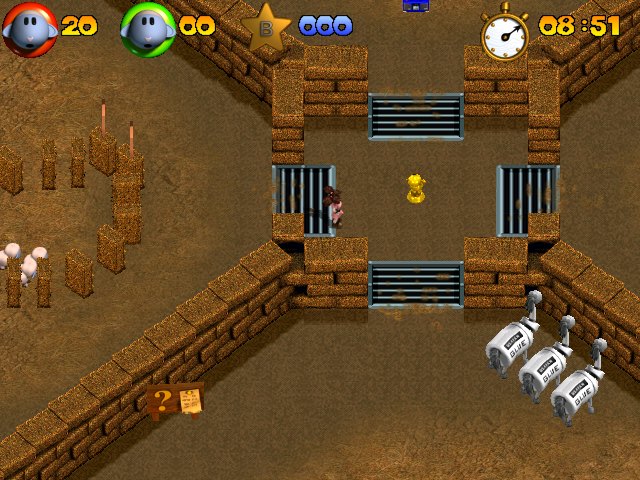
- Original
- 2000 · Mind's Eye Productions / Empire Interactive
- Technology
- Windows · DirectDraw 16-bit · DirectSound · Bink
- Approach
- Function-by-function port
- Status
- Playable — All 35 levels ported; full play-through pending
- You bring
- Your Sheep CD for Windows
Sheep is a herding puzzle from Mind's Eye Productions, published by Empire Interactive in 2000. You do not drive the flock so much as lean on it: the sheep keep away from you, so every level is a matter of standing in the right place, at the right moment, until they amble into the pen. Around that one idea the game builds six worlds — a polygon farm, a castle with a catapult, a circuit board in space, a desert of rope bridges, a city at night — each with a bonus game, plus a final level and four training levels on an army camp. It is gentle, odd and very much of its moment, and it ran on a stack of DirectDraw, DirectSound, DirectInput and Bink that modern machines no longer offer in the shape it expects.
OpenSheep is a from-scratch reimplementation of that game. It reads the original Sheep.exe from your CD for its tables and constants, but none of the original code runs: every function was ported by hand from the disassembly into portable C, with the original address cited above each one. The result runs on macOS, Linux and Windows through the gasm runtime, and in the browser.
The port is, in its own words, complete: the front end, all 35 levels, the flock, four shepherds, four breeds, power-ups, results, high scores, saves, credits, attract demos, movies, sound, music and the developers' own debug keys. What remains is verification — a full play-through, a side-by-side comparison with the original, and the twelve levels not yet covered by the regression run — and a first tagged release, which has not happened yet.
How it was rebuilt
The target is one exact build: Sheep.exe from the CD root, 380,928 bytes, CRC-32 b7bcd581, linked in January 2001 for a multi-language release. OpenSheep checks size and checksum at start-up and refuses anything else with a message naming both, because the whole port depends on reading that file's tables at known addresses (src/exe.h).
The original is MSVC C++ for Win32: a 640x480 16-bit DirectDraw surface, a DirectSound mixer working in hundredths of a decibel, DirectInput for keyboard, mouse and joystick, and Bink 1 movies through binkw32.dll. Ghidra, driven headless from the command line, decompiled it into a single greppable dump; a 292-line names file grew as functions were understood, and a summary tool mapped all 1,024 functions by size, strings and callees. A small capstone disassembler sat alongside for the cases where the decompiler's C is not to be trusted. The file formats — the .xp archives, RNC ProPack compression, run-length sprites, the level files — were decoded first in Python and then given readers in C.
The four hard rules in the project's AGENTS.md shape everything else: no original data or derivatives in git; no tables copied out of the executable (they are read at run time through accessors such as exe_u32 and exe_str, and even the registry value names come from the exe's own strings); the original address on every ported function and global; and no pasted decompiler output. The rule above the rules is that fidelity is the product. Quirks and bugs are kept and commented; only deviations of the port are fixed.
The new code is small and kept in its place. The core is about 23,500 lines of C11 that compiles natively as well as to WebAssembly, so no platform dependency can creep in; one file, src/platform_gasm.c, is the only one allowed to include gasm.h. It presents the rgb565 framebuffer, feeds the software mixer's output to the host, maps raw keys to DirectInput codes, and turns the registry and side files into storage keys. A Bink 1 decoder of its own, structured after FFmpeg's, plays the movies. The browser player is about a thousand lines of plain JavaScript modules on top.
The whole thing came together in 76 commits between the afternoon of 1 November 2026 and the evening of the next day — roughly 29 hours of agent time in one long session — the span of the commits, not counting the human time spent directing and reviewing it.
Notable stories
Zero bytes of game data
Most reimplementations keep a few tables they lifted from the original. OpenSheep keeps none. src/exe.c loads your Sheep.exe, maps its PE sections to their virtual addresses, and registered loaders fill C structs from it: level descriptors, menu pages, fonts, palettes, constants, even the breed and shepherd names through the exe's own pointer tables (c28a96e). The movie decoder does the same with binkw32.dll, reading its scan order, Huffman trees and quantisation matrices from the user's copy and checking them as it goes (src/bink.c). The price is a hard version pin; the reward is a repository with nothing in it that belongs to anyone else.
When the decompiler's less-than is not x87's
The original compares floats with fcom, fnstsw and a test of the flags, and that sequence treats an unordered result — a NaN — as "below". C's < says false. Two real gameplay bugs came from that gap. In one, a sheep's speed came out as 0/0; the original turns that into a target of zero, the port kept the NaN, and the speed ran away to −11.4 until the sheep stood 237 pixels off the map (38756d4). In the other, an acos of a dot product a hair past 1 produced a NaN that the original snaps to a path's first point; the port's comparison failed and sent the sheep to x = 0 (6251cb9). The lesson written into the workflow: read the flag test in the disassembly, not the decompiler's operator.
The sheep that vanished only in the browser
After a hurdle, sheep went missing — counted as lost — but only in the browser build. On a jump's landing tick the original reads its sine table at a negative index. On Windows that read lands in the tail of a draw list that happens to sit just before it and comes back as roughly zero; in WebAssembly the neighbour is an integer sine table, the float is a NaN, and the sheep's height goes with it. Running the native build under AddressSanitizer and UndefinedBehaviorSanitizer found it, along with a read one before the start of an animation array. Both are now guarded, with a comment saying what the original actually read (874afab).
Every random number in its place
The game draws from a 1,024-entry table filled from MSVC's rand seeded with zero. Forget to fill it and every draw is zero, which put every randomly placed object on one spot (b79cd8a). Fill it but miss a consumer and the whole stream shifts: generating the default high-score table takes 60 calls to rand at start-up, and porting it moved every level's hashes, which were re-baselined in a commit that says why (c4d7012). A saved high-score file skips that generation, so regression runs are made with empty storage. The run itself is 23 levels of 1,500 frames each, hashed and diffed against tests/hashes.txt, and the browser player has a mode that must produce the same hashes as the native runner.
A quirk worth keeping, and its one exception
In the original, a duplicated sound buffer starts with a base volume of zero rather than one, so every duplicate plays at −70 dB and only the first instance of an overlapping sound is heard. OpenSheep's mixer keeps that, as the original. The exception is music: a loaded music sound must still get its duplicate voice, and until that was found the walkman power-up never started its radio (c1feb7c).
Code the game only reaches by address
Each level's descriptor holds the executable addresses of its hooks — init, tick, draw, shepherd states, move routines, gates — so a missing port stays invisible until that path runs. The port maps each address to a C function and logs "not ported" once per unknown address (4bce89a), which turns long headless runs into a coverage report. Sometimes a level's own table names one of the standard routines, so those are now found by address as well (6eefabf); see src/levels.c.
Gallery
Standing on shoulders
The Bink decoder follows the structure of FFmpeg's libavcodec (rewritten, not vendored), with its tables read from your own binkw32.dll. The RNC ProPack unpacker ports the published Rob Northen Compression algorithm.
Tools throughout: Ghidra, Capstone, AddressSanitizer and UBSan and wasi-sdk. Gaps in these credits are bugs — tell us.
Getting a copy
You need your own Sheep CD for Windows. OpenSheep reads it in place: the original Sheep.exe (which must be the supported build — 380,928 bytes, CRC-32 b7bcd581 — or the game will say what it found and stop), binkw32.dll for the decoder's tables, the .xp archives and the Data/ folder with the movies and music. All told that is about 490 MB; the installer and DirectX on the disc are not used. Other releases of the game will not pass the check.
You can hand it over as the disc itself, a folder copy, an .iso, or a raw MODE1/2352 .bin — for a .cue and .bin pair, pass the .bin. In the browser player you pick the folder or the image, and it can copy the files into the browser's private storage so later visits start at once.
The project's guide covers installing, the game data, playing and the controls. No release has been tagged yet, so desktop bundles will appear on the releases page when the first one is cut; until then the build guide explains how to make your own.
Further reading
The project site is deliberately for players: its guide, the developer options and the gallery. The internals were moved off the site into the repository (e9b3ff1): notes/architecture.md has the address map, main loop and state machine, and notes/formats.md every file the game reads and the source file that reads it. What is still open lives in PLAN.md.
In the ENCORE guides, Sheep is a good companion to choosing an approach, the reverse engineering workflow and porting function by function; its x87 and memory-layout stories belong with floating point and the compiler and determinism and verification. The platform side is covered in building for gasm and graphics, audio, input, and the speed of the port — and how it outran its own verification — in working with agents and lessons learned.